AI Governance

OpenAI and Anthropic to set up election war rooms for U.S. midterms
Anthropic, Musk and the new Silicon Valley playbook: philanthropy through equity
token economy
2026-11-02 11:39:20

Who Uses Tokens? Excerpt from Understanding the Token Economy Examines Demand, Value and Risk

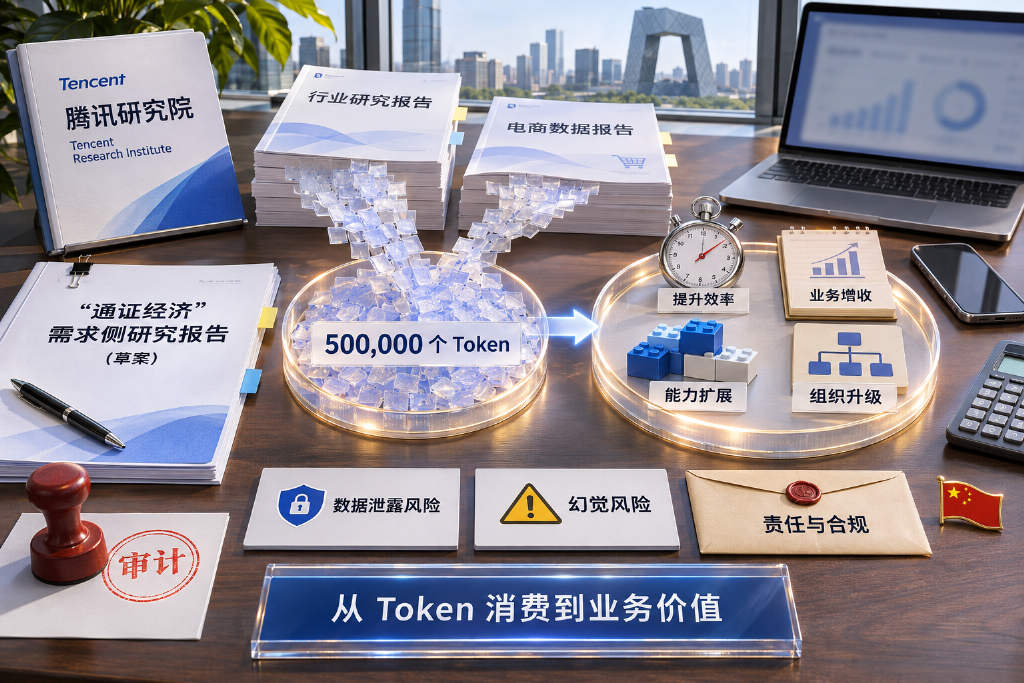
Tencent Research Institute’s WeChat account has published an excerpt from Understanding the Token Economy by Du Ning, CEO of Ruige Taike (Beijing) Technology Co., Ltd., under the title “Who Uses Tokens?” The piece shifts the discussion from the supply side of large-model infrastructure to the demand side, asking what token consumption actually accomplishes, how much labor it saves, and what kind of value it creates. The article argues that the core unit of measurement is changing from traffic and attention to task completion. In this framework, individuals use AI to extend their capabilities, enterprises use tokens to reorganize workflows and improve efficiency, and software systems or agents increasingly trigger token consumption automatically. It outlines five main paths through which tokens can turn into economic value: efficiency gains, revenue growth, capability expansion, organizational change, and knowledge discovery. The excerpt also focuses on enterprise management. It discusses token budgets, ROI, auditing, and what the author calls “token operations,” drawing a comparison with FinOps in cloud computing. It further distinguishes between low-value, mid-value, and high-value tasks, arguing that equal token volumes can produce very different outcomes depending on where they are used. The final section centers on risk. Hallucinations, data leakage, overreliance, fairness concerns, cost overruns, and unclear accountability are presented as key constraints on whether tokens can move from low-risk experimentation into high-value business processes.

310
Who Uses Tokens? Excerpt from Understanding the Token Economy Examines Demand, Value and Risk
UAE and OpenAI sign four agreements focused on AI governance
OpenAI updates Model Spec with five core values
FSB
2026-10-21 10:02:39

FSB sets out 12 governance practices for responsible AI use in financial institutions

The Financial Stability Board on Oct. 15, 2026 released its final report, Sound Practices for the Responsible Adoption of Artificial Intelligence in Financial Institutions, laying out 12 governance practices for firms using AI. The framework is split into two parts: four institution-level governance practices and eight practices covering the AI lifecycle from adoption and development to deployment and ongoing use. It addresses board and senior management oversight, accountability, documentation, materiality and risk assessments, model selection, data governance, explainability, performance monitoring, human oversight, cybersecurity, ICT risk and third-party dependencies. The final report follows a public consultation launched in June 2026 and closed on July 22, with about 160 responses from banks, insurers, other financial firms, industry groups, technology providers, academia and the public sector. Feedback broadly supported a principles-based and proportionate approach, while pushing for more operational detail. In response, the final version adds guidance on how smaller institutions can rely on existing roles and external expertise, expands examples across insurance, asset management and payments, and gives more attention to embedded AI, subcontracting chains, concentration risk, business continuity, exit planning and agentic AI controls. FSB frames the document as a practical reference rather than a binding rulebook. Financial institutions are expected to apply the practices in line with their size, complexity, role in the financial system and the extent to which AI is used in critical business functions, while still mapping each use case to local legal and regulatory requirements.

810
FSB sets out 12 governance practices for responsible AI use in financial institutions
NYC comptroller urges Anthropic to delay IPO until AI governance measures are in place
Ripple expands GSmart treasury AI with forecasting, liquidity and risk tools